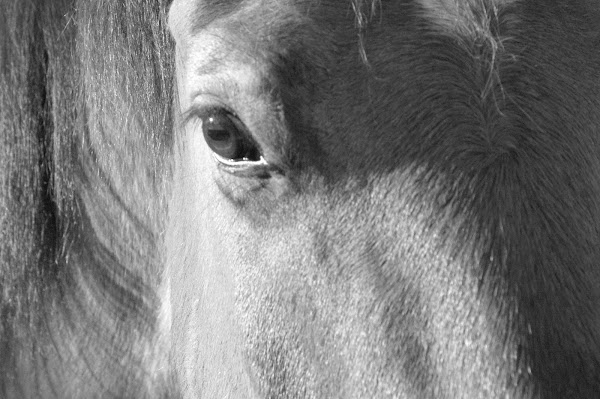

I had a lesson with a new trainer yesterday. The lesson was more along following the things I've learned by taking this different path with Mac, so most of it was ground work. Lisa, the new trainer, came to my place to work with us and asked me about challenges with Mac. The two things that I need to learn how to help him with are his braciness (is that even a word?) and his reactivity. Sure enough, she saw his reactivity when she had me do an exercise with him and I shook the flag and he, well, reacted boldly. She saw and understood that he has a strong instinct to flee and so she had us do a few different exercises to work on that; at one point she took him and showed me a new exercise that I'll try on my own.
She had an interesting explanation for a couple different horse personality types. A fearful horse, she explained, will spend a lot of time in fear mode, then move into defiance mode, but won't spend a lot of time there. A bold horse will spend a little time in fear mode, and more time in defiance mode before deciding to be with you. In the case of a horse being in fear mode, we should keep calm and have an energy that doesn't escalate the situation. There may be times when the horse is in defiance mode that we have to be a bit louder to be clear with what we're asking. In either case, she said we should have black and white boundaries of what we want, no grey areas that might confuse the horse.
She has a bosal that she brings with her and we tried to put it on Mac, but his nose is so big that it didn't fit. Hers is a 9" and he clearly needs a bigger one. I'm going to a Bryan Neubert clinic at the end of the month and I'm hoping he'll be able to help me find a size/style that fits Mac.
At the end, for the last 20-30 minutes, I got on. She had me do some bending exercises which are exercises that I've done in the past, but she suggested a different way to do them that did work better, both for my position, and for taking the brace out of Mac and producing a softer result.
It is so interesting to be taking this path. Surely I could get on and WTC and "just ride," but I find the work I'm doing to be very interesting in "getting to" Mac, in changing his responses from hard to soft, in creating a partnership, in getting to what makes him tick and how we can best work together.
I've got a new saddle on trial - a western-style Freeform treeless saddle. It just came in the mail yesterday (but too late for my lesson) - can't wait to try it today!
Saturday, August 17, 2013

Wednesday, July 10, 2013
Silly video
Ever see video from a helmet cam perspective? That's where the rider has a little video camera on the helmet and you can kind of get the feel of their ride from seeing it from there view. Well, I don't have a helmet cam. But I do have a cell phone with a video camera!
On yesterday's trail ride I decided to get out my cell phone and record a couple minutes of my ride in the beautiful pine forest. To do this, I had to take off my glove (I don't know about you but I can't handle a cell phone with gloves on), stuff it in the pocket of my fishing vest, take the holder off my phone and put it in the pocket also. Hold the camera in my right hand at the right height and hold my reins and my whip in my left hand. As a side note, I carry a dressage whip on the trail for many reasons, least of which is using it on my horse! Every now and then if I have good timing, I can actually swat a fly with it! I use it to mostly clear any cobwebs on a trail...those one-stringers that go from tree to tree and get on your face and are really annoying. I also use it to scratch my back, to get bugs off of Mac's neck, to flip his mane over just 'cause, to move a branch away, and I'm sure some other things that I can't remember at the moment.
Anyway, back to my video. So I've got my reins gathered, the camera on, and I'm ready to go. Off we go to a walk, then a little cluck up to a trot, then a little squeeze into the canter until the trail starts a slight gradual downhill and we go back to the trot. You hear my vest moving around a lot at the beginning so I sort of have to have my reins long enough that my left arm can be across my vest holding it still so it doesn't jostle all over the place and make noise. Then I've got to alternate looking in front of me where I'm going and at the phone screen to make sure I have Mac's head in the camera. And I decided to post the trot, too, so you'll notice that movement as well.
This part of the trail is covered in crushed rock/gravel, so his footsteps are really loud . . .and he's barefoot, so that's cool.
At about 1:50, I think, you'll hear me exhale loudly. That's my "downward shift" cue to walk. Then later on I also do it again and that's my walk-halt cue. Of course I use my body, too, but Mac really listens to that breath.
So here's the blurry and wobbly video for you to enjoy!
Tuesday, June 25, 2013
Lions and tigers and bears, oh my!
Ok, not lions. And not tigers. But one bear - oh, my!
On Sunday Mac and I had a lovely trail ride with some new friends (Mac's girlfriend from the Buck Brannaman clinic and her mare friend) - we went up to the forest to enjoy a light rain shower in the tall pines as we guided our horses along the single-track trails through the trees. Just as we were walking down the last 100' of trail to turn to a smaller trail that would begin our loop home, a BEAR crossed our paths!
I've been trail riding at this location for 9 years now. I know there are bears up there, but until now I had never seen one. Based on the short time I got to see it, I would estimate that it was 400 lb. or so, so not a huge bear, but certainly a bear of substance (well, aren't they all?).
Deciding that chasing after a bear wasn't the wisest thing to do, we turned around to take a different trail back. The horses weren't hugely spooked, but they definitely knew that something big and potentially scary crossed their paths. As we turned the other way, there was just a bit of tension in the air.
My words as a yoga teacher kicked in and I followed my own advice. Sensing the potential tension in the situation, I focused on my breathing. I frequently talk about how changing your breath can change your body's response - and as riders, we know that our horses feed off of our energy, so changing our response changes their response. Recognizing that my breath could help keep anxiety to a minimum and create a sense of calm right away, I focused on breathing into my belly. Inhale, belly expands against waistband; exhale, belly contracts; repeat. I focused only on belly breathing, keeping my center of gravity low and my shoulders relaxed and releasing tension with each exhale.
And you know what? It worked! What could have been a scary situation didn't escalate at all. It took about two seconds for my body to respond and my horse to respond and we turned and went on our merry way down a different trail, loopy rein and all.
Sunday, June 23, 2013
Pony rides!
My husband is horse shopping, which is always fun in theory, but never fun in practice. In order to get him some saddle time so he gets a little bit more "riding fit" for trying new horses, I gave him a lesson on Mac yesterday. Since Mac has been so good lately, I figured I'd get on and warm him up just to make sure he's in a good mood, and then give DH a lesson.
Well they both did a great job! Not that I expected Mac to take off bucking or anything, because I didn't, but I didn't expect him to be as accepting of a new rider as he was. Aside from maybe two other times when someone else has gotten on him in the past three years, I am the only person to have ridden him since I got him, so I wasn't entirely sure what to expect. Mac did test DH a bit, by leaning into the left circle, mostly, but once I told DH how to ride Mac so that he's balanced, he got the hang of it and they had a lovely ride. They walked, trotted, cantered, and did some trot poles. Actually, compared to the other horses that we've had DH do a test ride on, his ride on Mac was actually the best!
Perhaps next time I'll get a picture - I think this will be a regular occurrence.
Wednesday, May 29, 2013
New videos - with new bridle!
Yesterday's ride was an exercise that served two purposes: 1) to prove that doing ground work before riding IS important, and 2) that I shouldn't be lazy about not doing ground work. I set up the video camera at the end of the arena, so the video quality isn't good - there's no following zooming-in and zooming-out, and at parts of the video I go out of view. Still, it is good to have on hand to show me what I need to work on. Which is not being lazy and skipping my ground work exercises.
I tried to do some of the ground work exercises under saddle and was moderately successful. For some reason the opening-rein-leading-the-inside-foot-in-a-turn is more difficult to the right. Had I not been so determined to NOT do ground work and prepared Mac ahead of time, it may have gone better. Well, something to remember for next time.
I also tried to do some backing exercises under saddle. Again, had I done my ground work beforehand, it might have gone more smoothly. Here's a video of us backing and then turning to the inside to change direction and picking up the trot; repeat.
I found Mac to be more braced than when I do my . . . guess what!? . . . ground work ahead of time. I tried to work through some of this with starting some leg yield work. I had actually done a modified leg yield zig-zag a couple days ago and it went really well. Due to the size of my arena, though, I had only room for a zig and half of a zag. Yesterday I cut the leg yielding short because I didn't want to go out of frame. Anyway, this video shows our attempt at that.
In our trot and canter work, I tried to work on keeping my hands steady and quiet, and I think I did a good job of that. After watching how Buck warms up on such a loose rein, I wanted to try that as well, but I turned out to be somewhere in between loose rein and contact, with my reins too long and Mac in sort of an in-between posture.
Here we are cantering left.
And here we are cantering right.
I was really hard on myself last night after watching the whole video. So of course I spliced it up into smaller videos that I didn't hate so much and when I look back on them today they don't look as bad as I thought. I was just disappointed in myself because I've been feeling like we are so *right there* together and in synch. And it comes from doing ground work. And I didn't do it yesterday, so I was working with a braced feeling and not the lightness that I have been feeling.
Well, lesson learned!!
Today I DID do ground work before riding and had a very lovely ride, thankyouverymuch. I just don't have any video to prove it! ;-)
Tuesday, May 21, 2013
And the work continues
So armed with a headful of new ideas from the Buck clinic I came home to practice what I learned. For the first few days after the clinic I continued to work Mac in the rope halter before I got on. Soon enough, though, I decided to just bridle him right away and take him out to the arena. I still do a bit of ground work before mounting, but in the bridle instead of the halter.
Some of the exercises I do are the "drift" exercise, moving forward and back from a soft feel (with me standing in front of him), backing in circles, and moving "off the leg" from a bump with the stirrup. Then I get on and work on the short serpentines, small circles with the front crossing over, small circles with the hind crossing over, then putting those together for the 180/180 exercise. I also work on longitudinal flexion after doing those lateral flexion exercises. At the halt I ask him to give to contact and then release. From there, I move into backing, and then backing and finishing with moving the front legs around 180 to change direction. Of course in a perfect world this would all go smoothly and easily, but each day is new and some days are better than others.
Today was the first day I rode Mac since last Wednesday, as I work a full day on Thursdays and then Friday went out of town with Paddy to drop him off on trial for a lease. Then I had to work a full day yesterday. The wind is up today and Tomato (my husband's horse) has now realized he is alone in the pasture and so was calling out a bit while I was out with Mac. Mac was very good and did not call back and did not seem nervous in the least to be out alone - not that he ever is, but circumstances have changed with us now having two horses instead of three.
Mac was a little looky with the wind blowing, but he was very very good! At the times he wanted to drop his inside shoulder and move away from the rail, I slid up on the inside rein and practiced a 1-rein stop. After all the warm-up exercises mentioned above, we had a trot around and again when he was feeling a bit distracted I worked on circles. I talk to my horses when I ride, so I told Mac, "I have all day to ride you. I have nowhere to be but here, so we can work on figure-8 circles until the cows come home - which is not a good deal for you, my friend, since we have no cows!" Adopting this mind set let me settle into the work and he settled into the work also. I worked on refining my geometry and making good circles and finding opportunities to soften so he could be rewarded for carrying himself in a soft way. It was a great approach and we didn't have to spend too long on the circles.
We went to more trot work with the feeling of collecting for a few steps, and then moving out down the long side; collect a few steps on the short side, move out on the long side. That went really well! So from there we worked on transitions and then moved up into the canter and did some transitions there. It was a great ride.
I'm really enjoying this connection with Mac, and I think he's finding me to be trustworthy, reliable, consistent, and a good leader - at least I hope so, anyway!
I'm working on seeing if I need to adjust his saddle at all so while I was taking pictures for the saddler, I got one of him standing tied. Unfortunately the shadow from the pole is right on his face so you can't see how cute he looks, but you can see my new saddle pad!

Friday we meet up with his girlfriend Winnie for a trail ride - THAT should be FUN!!!
Saturday, May 11, 2013
Buck Brannaman clinic report - day 4
Sigh. It was the last day of the clinic. As I mentioned, I bought a western bridle and had one of the guys at Frecker's (the saddle shop that was selling lovely saddles and bridles and bits and spurs and mecate (is the plural mecates?) and bosals and all sorts of other wonderful things) assemble the mecate and headstall with my bit. I had to watch carefully because when I got home I bought a new bit (they were sold out at Frecker's at the clinic) and would have to disassemble and reassemble it on my own!
Here I am at home, trying to figure out the mecate before taking it apart and putting my new eggbutt plain snaffle on.

Anyway, on the night of day 3 I had already done my riding homework and Mac had been so good that I just put the new bridle on him and practiced flexions. My first reaction was that I could "feel" more - or maybe Mac could feel more, because it seemed I could have a lighter contact with the mecate to get the same response as in my english bridle but with a heaver feel. I wonder if it is the weight of the mecate rope and the slobber straps that offer the horse a "pre-cue," so to speak, to tell him that something is coming? In any event, it was an interesting difference.
So the last day came and Buck wanted us to be ready to ride in the clinic right away; meaning, do your ground work before class starts and be ready to get on. When I brought Mac in to the arena ahead of time, as I had done every morning prior, he was quiet and settled. There didn't seem to be any tension, and I felt like I didn't have to do as much ground work as the previous mornings in order to get him to the same soft and ready-to-work spot. So, gulp, I got on. There were a couple other people mounted but everybody else was doing ground work. Mac felt so good underneath me! I practiced the one-rein stop from the walk, we trotted forward, we trotted in circles around other people, and if I felt him falling in to the circle, I would use a modified one-rein stop to get him to disengage the hind end, then continue forward. I think this is what Buck was referring to as the drift, so I'll talk about it for a moment.
Buck spoke of the drift in the classes, but he didn't have anyone practice it. I think I was actually already practicing it, so I think I understand what it is. When having the horse circle, change your body position and rope position to move back toward his haunches so he disengages for a couple strides. Then ask him to move out on the circle again. So you don't come to a stop, you have the horse just cross over behind for a couple steps, then go forward again. This is an excellent set up for the very thing that I tend to have trouble with when I first start a ride - Mac will get heavy on his inside shoulder. What he needs to do is line up his haunches and he also needs to understand the connection with my rein to his hind leg. This exercise helps with that and was one thing I was practicing before class started.
The last morning of questions someone asked about a horse who is terrified of cows. Buck had an interesting comment about horses and cows. I'm paraphrasing, of course, so I hope I'm correctly summing up what he said. He said the first time he heard of a horse afraid of a cow, he thought it was a joke because in his experience with working ranch horses, horses inherently know they are superior to cows. Horses are faster than cows and they know they can move them around. Otherwise, he said, we'd ride cows and rope horses . . . that got a good laugh. To work with this problem, change your approach (your, as in the person) to the cow. Instead of being scared of the cow and thinking you hope your horse doesn't spook at it, think "I'm gonna git you, cow!" and move with the intent to move the cow. Once the horse realizes that he makes the cow move (just like the dominant horse makes the lower horses move), then the story changes and the horse becomes confident.
So back to the riding part. We all mounted up and Buck had us working on the same things the other classes had been working on from day 1: short serpentines and the 180/180 exercise. He watched us as we played around with that for a while and I'm happy to say that Mac was totally focused on me this last day, and I was totally focused on him. I wasn't worried about where other horse/rider combinations were, I wasn't worried about who was doing what, I completely forgot that there might be anyone watching us (even Buck!), and I was really in the moment and in the exercise. Now, that doesn't mean I did the exercise perfectly, of course, but I did have moments of getting it and so I would keep hunting those moments.
After working on those on our own for a while, Buck had us see if we could take a soft feel on the reins and practice a bit of longitudinal flexion at the walk. Then we'd take a soft feel and stop; then walk forward; then do a serpentine or 180/180 - basically we mixed it up a bit with all the things we had been practicing. He had us change direction with purpose, paying attention to our timing . . . this is a funny thing. Not ha-ha funny, but interesting. I find I'm guilty of this so often, and I saw other people in the other classes were, too. When doing an exercise, one can be so intent on trying to do it right - there's a lot of try there and a lot of attention to detail. Yet when the exercise is over and we stop for a break or chit chat, we stop feeling of the horse, we stop riding. The first time I noticed he drew attention to this was with one of the riding classes earlier in the clinic. When he asked people to reverse direction, they just fell apart and stopped focusing on their feel and timing. I don't know why that is, but I get it and I'm guilty of it as well. Basically, we should be riding with purpose and quality all the time!
Buck mentioned a time when he was riding one of his horses . . . actually, I don't remember the set-up, but I don't think it was in a clinic. Anyway, he came in from his ride and someone asked him how it went and he said he had a good ride. The other person said "but you didn't do anything, you just stood there!" Buck commented that to an outsider maybe that's all it looked like; but to him, he was developing feel and timing the whole time. He was working with the horse on such a subtle level of shifting weight in response to cues that to someone who wasn't paying attention, it looked like nothing was going on. That level of subtlety is certainly something to strive for!
In our closing circle Buck said he was proud of all of us - we tried hard, we did good work, the horses progressed throughout the clinic. On the first day he said he "hates Fridays and loves Mondays" because Fridays are a bit chaotic, but Mondays are the days when it all comes together and you can see the results of everyone's efforts. It was a bit melancholy, too - the energy had changed because we'd all be leaving after this.
I wish I could do the clinic justice in my writings here. He shared so many stories, but if I wrote them all down at once it would make your eyes bleed from reading them! I learned so much by watching so many different teams work together. I learned so much by listening to his lesson-disguised-as-an-anecdote. You may think he just has funny stories to tell, but each one is a lesson in humility, grace, leadership, and life.
My goal is to continue attending clinics, to continue watching my 7 Clinics DVDs over and over and over again, to seek out quality people to learn from, to trust my own instincts when it comes to my horse, to never stop learning. It was truly a life-changing experience. And you know what? The last day Mac didn't call out to anyone while we were in class - that was my question for Buck at the beginning, and at the end, I had Mac's full attention. Well, almost . . . at the very end of class, in our closing circle, Winnie his neighbor and new love did quietly nicker at him - and he nickered back.
There was a photographer there who was taking pictures but I think it will take a while for her to get them up, so I'll share just one more that my friend took. This is me and Mac. I'm hot and sweaty after day 2 and I'm waiting to have my picture taken with Buck. Mac is calling out to one of his many friends, so his nostrils are flared. But I love the alert expression in his eye, the strength of his head, the trust he places in me to lead him through this adventure.

Subscribe to:
Posts (Atom)